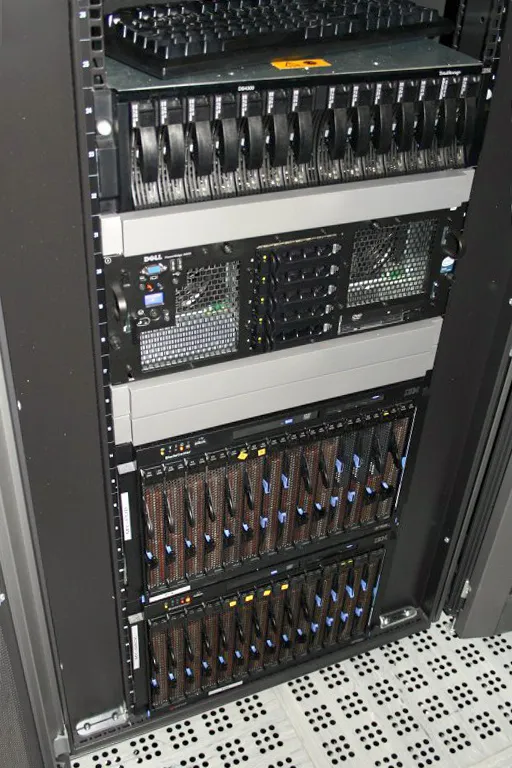
Offline and Unbothered: The Americans Quietly Killing Cloud Sync for Good
Photo: Credit Line: AIP Emilio Segrè Visual Archives, Gift of Bill Woodward, USNS Kane Collection, CC0, via Wikimedia Commons
Somewhere in a suburb outside Columbus, Ohio, Marcus Delaney is editing a 4K video project on his home workstation. His footage syncs automatically to a NAS drive in his basement. His phone picks up the latest cut without a single byte touching Amazon, Google, or Apple's infrastructure. Nobody is scanning his files. Nobody is charging him $9.99 a month for the privilege of accessing his own work.
Marcus isn't a security researcher or a professional sysadmin. He's a high school art teacher who got fed up.
"I realized I was paying three different companies to hold my own stuff hostage," he says. "iCloud kept nagging me about storage. Google Photos changed its free tier. Dropbox wanted more money for features I used to have. At some point I just thought — why am I doing this?"
Marcus is part of a quietly swelling movement in American tech culture: the local-first migration. People are abandoning the seamless-but-surveilled world of cloud synchronization and rebuilding their digital workflows around tools they actually own and control. The reasons are as varied as the people doing it, but the destination is often the same — a setup where your data lives on your hardware, moves on your terms, and answers to nobody but you.
Why Now? The Cloud's Broken Promises
For a long time, cloud sync felt like a genuine miracle. Your photos appeared on every device. Your documents followed you everywhere. You never lost anything. The trade-off — giving corporations access to your files in exchange for convenience — seemed abstract enough that most people didn't think twice.
Then the terms started shifting.
Google Photos ended unlimited free storage in 2021. iCloud's free tier has been stuck at a laughable 5GB for years while Apple nudges users toward paid plans. Dropbox quietly killed its unlimited offering. Microsoft 365 bundles OneDrive in ways that make opting out feel like surgery. The convenience was always real, but so was the dependency — and people are only now reckoning with how deep it runs.
Beyond pricing, there's the surveillance dimension. Cloud providers routinely scan files for policy violations, serve targeted ads based on content, and cooperate with government data requests. For most users that's a background hum they ignore. But for a growing number of Americans, it's become impossible to tune out.
"I had a friend whose account got flagged and locked — no warning, no appeal that actually worked," says Priya Nair, a freelance photographer based in Austin. "She lost access to years of client work. That scared me straight."
Priya now runs Nextcloud on a refurbished server she bought for $180 on eBay. Her photos sync to it automatically. Her clients get password-protected galleries hosted on her own domain. She pays for electricity and a domain name. That's it.
The Local-First Toolkit
The good news for anyone considering a similar move is that the tooling has never been better. A few years ago, self-hosting required serious Linux chops and a high tolerance for configuration pain. Today, the barrier is dramatically lower.
Syncthing is probably the most approachable entry point. It's free, open-source, and peer-to-peer — meaning your files sync directly between your devices without passing through any central server. Setup takes maybe twenty minutes. There's no account to create, no company to trust, no subscription to forget about. Files on your laptop appear on your desktop, your phone, your home server, wherever you want them — encrypted in transit and never stored anywhere you don't control.
Nextcloud is the heavier option, but it's also the most full-featured. Think of it as building your own Google Workspace: file storage, calendar, contacts, document editing, video calls, photo backup — all running on hardware you own. The Nextcloud community has made installation significantly easier with one-click installers and well-maintained Docker images. If you're comfortable following a tutorial, you can have a working instance in an afternoon.
For users who want something in between, Resilio Sync offers a polished peer-to-peer experience with a gentler learning curve, though its free tier has some limitations. And for pure document collaboration without the file-sync overhead, tools like CryptPad and Standard Notes offer end-to-end encrypted alternatives to Google Docs and Evernote that can be self-hosted or used on community-run servers.
The Philosophy Behind the Plug-Pull
Ask local-first converts why they made the switch and you'll hear technical answers, sure — but you'll also hear something that sounds a lot like a values statement.
"I got into open source because I believe software should serve users, not the other way around," says Daniel Osei, a backend developer in Seattle who maintains a Nextcloud instance for himself and four family members. "Cloud sync as it exists today is the opposite of that. You're the product. Your data is the inventory."
This isn't just tech-bro libertarianism. There's a genuine progressive current running through the local-first movement — a belief that data sovereignty matters, that surveillance capitalism has real costs, and that the path to digital freedom runs through infrastructure you actually control. For many people in this community, self-hosting isn't a hobby. It's a political act.
That framing might sound dramatic until you consider what's at stake. Your photos document your life. Your documents contain your thoughts. Your calendar maps your relationships and routines. Handing all of that to corporations whose business model depends on monetizing behavioral data is, when you slow down to think about it, a pretty significant concession.
The Convenience Question
Here's the thing skeptics always bring up: doesn't this make your life harder? The honest answer is — a little, at first. There's a setup cost. You need hardware. You need to learn some new tools. You might spend a weekend getting things configured.
But most people who've made the jump report that the ongoing experience isn't significantly more friction-filled than what they left behind. Syncthing runs silently in the background. Nextcloud has mobile apps that handle photo backup automatically. Once it's working, it mostly just works — without the nag screens, the storage warnings, the price hikes, or the nagging feeling that you're being watched.
Marcus, the teacher from Columbus, puts it plainly: "After the first two weeks, I genuinely forgot I'd changed anything. Except I stopped getting those 'Your iCloud storage is almost full' emails. That part I definitely noticed."
Priya in Austin says the shift actually simplified her workflow. "I used to have stuff scattered across Google Drive, Dropbox, and iCloud because different clients used different things. Now everything is in one place. My place."
Making the Move
If this is sounding appealing, the practical path forward is more accessible than you might think. Start with Syncthing — it's free, it's low-risk, and it'll give you a feel for what local-first actually means in daily use. Pair it with an external drive or an old computer running as a home server, and you've got the bones of a real self-hosted setup.
When you're ready for more, Nextcloud's documentation is genuinely solid, and communities like r/selfhosted and the HypeOS forums are full of people who've been exactly where you are and are happy to help.
The cloud isn't going anywhere. Big Tech will keep making it frictionless and seductive and cheap enough that most people won't bother questioning it. But for the Americans who are asking harder questions about who owns their digital life — and building the answers themselves — the local-first movement is already here, already mature, and already waiting.
Your files. Your hardware. Your rules. The only thing left is flipping the switch.